
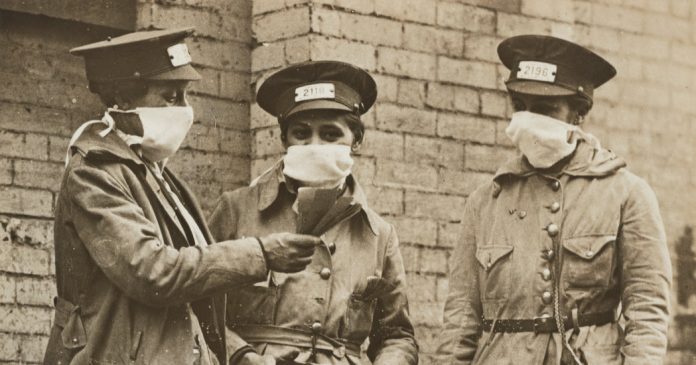
The wire arrived in New York City from an incoming ship at sea, announcing that 10 of its passengers and 11 crew members were ill. So a team of doctors and officials waited at a Brooklyn pier to greet the Norwegian vessel Bergensfjord and, with it, the first cases in the city of the deadliest pandemic in modern human history.
It was Aug. 11, 1918. The ship docked, the sick were rushed to nearby hospitals, and the pier was placed under quarantine. Everything appeared to be under control. Then more sick arrived.
The illness spread, racing through crowded neighborhoods and tenements. The numbers rose slowly at first, then soared as if swept in on a huge wave — a pattern eerily familiar 102 years later.
It was the Spanish flu, and it would kill tens of millions of people worldwide, including 675,000 people in the United States. In New York City, more than 20,000 died, at a rate of 400 to 500 a day at its apex. It was a bracing death toll — and yet city leaders saw it as a sign of a job well done after the fact. It could have been much worse.
Today, looking back at the response to the pandemic of a century ago from the street-level vantage of shelter-in-place apartments is to watch, in many ways, our own current experience with a sepia tint. City leaders struggled with the same decisions then as today.
“Do you close the schools? Do you close the subways?” said Sarah Henry, chief curator at the Museum of the City of New York. “Do you quarantine people?”
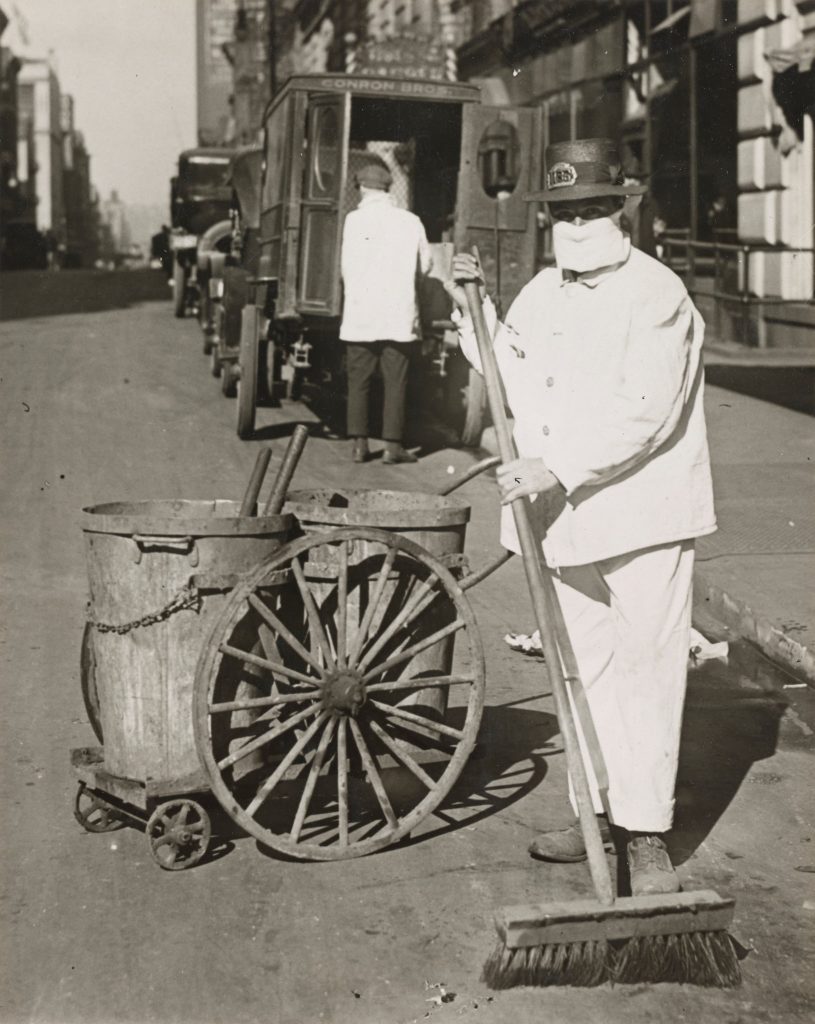
© National Archives
But in other ways, the experience of 1918 was altogether its own: a different flu, a different city. The first death in New York City was recorded about a month after the Bergensfjord arrived, and the numbers rose rapidly.
“And they were hard deaths,” wrote Mike Wallace, a historian, in “Greater Gotham: A History of New York City from 1898 to 1919.” He described “patients gasping for breath as their lungs filled with bloody frothy fluid.”
The city had a new mayor, John Francis Hylan, a former laborer for the transit system who earned a law degree before entering politics. He had only just appointed a new health commissioner, Royal S. Copeland, whose credentials were questionable to some (“dean of a homeopathic medical school,” wrote John M. Barry in “The Great Influenza,” and “not even an M.D.”).
Now, Mr. Copeland suddenly faced an almost unimaginable crisis.
New York City was a perfect breeding ground for a flu. Rush hour had just been created with the installation and expansion of the subway and elevated trains. The earliest commuters packed the cars. Water fountains that featured a single community cup had only recently been done away with by a “Ban the Cup” campaign.
“It was believed, at the time, that that was safe because the cup was always being washed by the water,” Ms. Henry said.
There were calls to shut down the city’s theaters, but Mr. Copeland saw them as a chance to educate and kept them open.
“In every theater, before the entertainment began, someone appeared before the curtain and explained the danger of infection from coughing and sneezing,” Mr. Copeland told The New York Times that year. “The audience was told how influenza spreads and how to protect themselves and others.”
Public-service campaigns flourished, in the form of pre-internet, pre-radio and pre-television media, such as leaflets and posters. They sought to curb all manner of bad habits, from unprotected sneezing and coughing to spitting in the streets. The city’s Boy Scouts walked the streets, patrolling for spitters.
“If they spotted someone spitting publicly, they would hand out a card to teach them they were endangering the city,” Ms. Henry said.
Then there were the schools.
“The first thing that was done almost everywhere but New York was to close the schools,” Mr. Copeland explained that year. “They may have been just the right things to do in those places; I don’t know their conditions. But I do know the conditions in New York, and I know that in our city one of the most important methods of disease control is the public school system.”
Most school children lived in tenements, “frequently unsanitary and crowded,” with parents “occupied by the manifold duties involved in keeping the wolf from the door,” the health commissioner explained. Left unwatched, they’d be running in the streets, so schools were seen as not just preferable, but vital for children.
“They leave their often unsanitary homes for large, clean, airy school buildings, where there is always a system of inspection and examination enforced,” Mr. Copeland said.
The city allowed businesses to stay open, too, staggering their hours of operation to prevent crowded trains and commutes. “White-collar offices would open at 8:40 and close at 4:30,” Mr. Wallace wrote. “Wholesalers would start their days earlier, non-textile manufacturers would start later.”

