

On this tour, you will see the Harbour Islands as they were hundreds of years ago. You will learn about the first New Yorkers, discover thousand-year-old fishing and hunting camps, and see the burial places of those who once stayed on the islands. You will sail past the earliest-known remains of the city’s Dutch settlement and visit some of the forts that protected the harbor. You will also see the final resting place of the ferry that carried thousands of immigrants on the last leg of their journey to the New World.
The harbor itself, one of the finest in the world, has enormous historical significance. It was through here that Henry Hudson sailed on his famous voyage, a passage that led to the arrival of the first European colonists, and it was through here that millions of immigrants sailed on their way to start their new lives in the United States. The size and sheltered position of this splendid harbor helped New York become the nation’s largest city and primary port, positions that it held for well over a century.
Site 1: Castle Clinton
The tour begins at Castle Clinton National Monument in Battery Park in lower Manhattan. Take the 1 or 9 subway train to South Ferry, the 4 or 5 subway train to Bowling Green, or the N or R subway train to Whitehall Street, and walk south through Battery Park to Castle Clinton at the tip of Manhattan.

It is a circular sandstone fort designed by engineer Jonathan Williams, who also designed other fortifications of New York Harbor. Castle Clinton was built in 1808–11 to protect the city and guard access to the Hudson River. Although today it is located on Manhattan Island, it originally stood 200 feet offshore, in 35 feet of water, on an artificial island made just to support it—a remarkable engineering feat for its time.
It was the first U.S. immigration station (predating Ellis Island), where more than 8 million people arrived in the United States from 1855 to 1890. Over its active life, it has also functioned as a beer garden, exhibition hall, theater, and public aquarium. Castle Clinton National Monument was listed on the National Register of Historic Places on October 15, 1966.
Site 2: Governors Island
As the boat leaves Battery Park to cross the harbor toward Liberty Island, look at the island on your left. This is Governors Island, by far the largest island in the Upper Harbor.
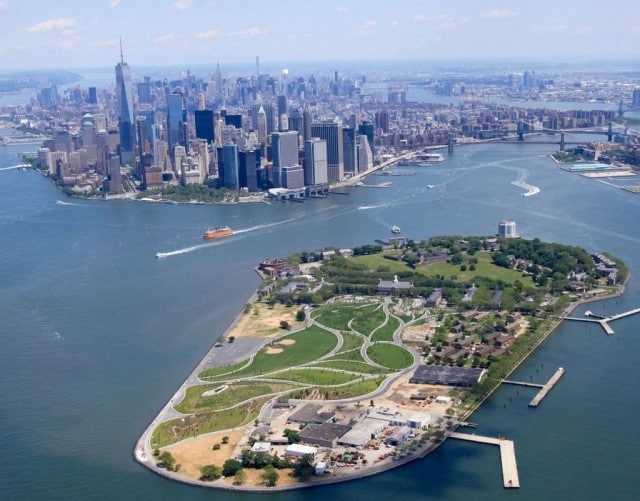
The native Lenape originally referred to Governors Island as Paggank (“nut island”). The name was translated into the Dutch Noten Eylandt, then Anglicized into Nutten Island, before being renamed Governor’s Island by the late 18th century.
The island’s use as a military installation dates to 1776, during the American Revolutionary War, when Continental Army troops raised defensive works on the island. From 1783 to 1966, the island was a United States Army post, serving mainly as a training ground for troops, though it also served as a strategic defense point during wartime.
The island then served as a major United States Coast Guard installation until 1996. Following its decommissioning as a military base, there were several plans for redeveloping Governors Island. It was sold to the public for a nominal sum in 2003, and opened for public use in 2005.
Site 3: Liberty Island
Disembark at Liberty Island, home of the Statue of Liberty, one of the most famous American icons. As you visit the sites and enjoy the views of the harbor, bear in mind that the present park sits upon a rich buried past. On the west side of the island, archaeologists found traces of a thousand-year-old Native American site, which was overlain by a midden, or trash heap, dating to the late eighteenth or early nineteenth century.

Site 4: Ellis Island’s Main Building
Continue on the ferry to Ellis Island. It is a federally owned island in New York Harbor that was the United States’ busiest immigrant inspection station. From 1892 to 1954, approximately 12 million immigrants arriving at the Port of New York and New Jersey were processed there under federal law. Today, it is part of the Statue of Liberty National Monument, accessible to the public only by ferry. The north side of the island is the site of the main building, now a national museum of immigration. The south side of the island, including the Ellis Island Immigrant Hospital, is only open to the public through guided tours.

The present three-story main structure was designed in French Renaissance style. It is made of a steel frame, with a facade of red brick in Flemish bond ornamented with limestone trim. The structure is located 8 feet (2.4 m) above the mean water line to prevent flooding. The building was initially composed of a three-story center section with two-story east and west wings, though the third stories of each wing were completed in the early 1910s. Atop the corners of the building’s central section are four towers capped by cupolas of copper cladding.
Some 160 rooms were included within the original design to separate the different functions of the building. Namely, the first floor was initially designed to handle baggage, detention, offices, storage, and waiting rooms; the second floor, primary inspection; and the third floor, dormitories. However, in practice, these spaces generally served multiple functions throughout the immigration station’s operating history.
Site 5: Ellis Island’s Wall of Honor
The next stop is an open-air exhibit at the Wall of Honor, behind the Main Building, to the left of the door leading outside from the cafeteria. The display is in two parts, both outside and inside the circular wall.
The Wall of Honor memorializes the family experiences of the 775,000 names inscribed upon its panels and represents the journey of every person who has ever pursued the promise of a better life. It commemorates families who came here by ship, by plane, and by foot; honors those who endured forced migration from slavery; and remembers our own earliest settlers, America’s indigenous peoples.
Names can be viewed and added to the Wall of Honor database online or while visiting the American Family Immigration History Center at Ellis Island. New names are engraved into the Wall panels annually.

Site 6: The Old Ferry Slip at Ellis Island
When you have finished visiting the museum, walk over to the old wooden ferry slip and art deco ferry building at the head of the modern slip where today’s ferries tie-up. This ferry building was built in the 1930s, as part of a Works Progress Administration project. In 2009 the remains of sunken ferry Ellis Island were recovered from the slip.

The boat had been put into service in 1904, and it continued as the only regular ferry connecting Ellis Island with Manhattan for half a century until the immigration center closed in 1954. In other words, the ferry had transported almost all of the 12 million immigrants who passed through the island on the way to their new lives.
Site 7: The Harbor and Staten Island
As you wait for the ferry to bring you back to Manhattan, enjoy the spectacular view of the harbor and notice particularly Staten Island, to the south, behind the Statue of Liberty and just to the right of the Verrazano Narrows Bridge. This large suspension bridge connects Staten Island and Brooklyn.

Return on the ferry to Battery Park in Manhattan, where you can catch the 1 or 9 subway at South Ferry, the 4 or 5 subway at Bowling Green, or the N or the R subway at Whitehall Street.

