
In the heart of what is now the Financial District runs a street with a curious name, and an even more interesting past. Known by film buffs as the inspiration for the 1936 crime movie, 15 Maiden Lane, Maiden Lane is so much more than it appears. Maiden Lane is an east-west street in the Financial District of the New York City borough of Manhattan. Its eastern end is at South Street, near the South Street Seaport, and its western end is at Broadway near the World Trade Center site, where it becomes Cortlandt Street.
[streetview view=”embed” width=”100%” height=”480″ title=”44 Maiden Ln, New York” lat=”40.70856234897318″ lng=”-74.00847921197555″ heading=”148.87929976096729″ pitch=”-9.419754066829853″ zoom=”0.9999999999999997″][/streetview]
The WPA Guide to New York City described it as “a footpath used by lovers along a rippling brook;” while in all probability, lovers certainly did carouse along the creek, the pathway was also called “Maiden Lane” because of the popularity of the nearby brook among mothers and daughters as a place to do the family laundry on sunny days.
[pdf-embedder url=”https://www.hellobigapple.net/wp-content/uploads/2018/02/Maiden-Lane.pdf” title=”Maiden Lane”]
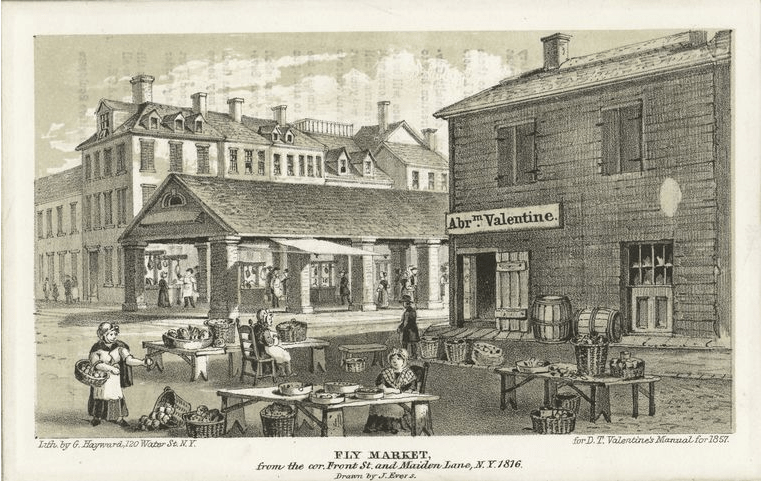
Fly Market on Maiden Lane
The street was formally laid out in 1696, the first street north of still-palisaded Wall Street. After the street was laid and cobbled, its southern-most end (what would have stretched into Fly Market Slip in the late 1600s/early 1700s) quickly became home to the popular Fly Market a year later, so named thanks to a corruption of the original Dutch word for valley, “vly,” which was often used to describe the natural geography of the area.
The Fly Market offered fresh produce, fish, and meat under a covered roof, and while it lived to become New York’s longest running market, by 1815, city residents requested that it be disbanded and demolished due to its increasingly filthy and inconvenient state. By 1823, the market had closed for good, giving itself over to the newer Fulton Fish Market, and later, the New Amsterdam Market. The Fly Market, and its successor the Fulton Fish Market, which moved to the Bronx in 2005, was one of New York’s earliest open-air fish markets.
Maiden Lane was a street of shops by the end of the 18th century, even before the new fashion for multi-paned shop windows caught on in the city. In 1827 the skylit New York Arcade, banking on the fashionable success of London’s Burlington Arcade (1819), spanned the block between Maiden Lane and John Street east of Broadway with forty smart shops. However, while regarded as beautiful by many, it was also financially disastrous, and Charles Haynes Haswell recalled that “it had not the success that had been anticipated…and survived but a few years”.
Maiden Lane was soon one of the first city streets to be lit with gas lamps, which led to its being a popular shopping street. The slip at the foot of Main Lane was infilled in the early 19th century, accounting for the widened stretch in the last blocks before South Street, the present waterfront. The water of the erstwhile brook ran down the center of the street, until 1827, when a suggestion was made in Common Council to close it over and lead rainwater to the side gutters.
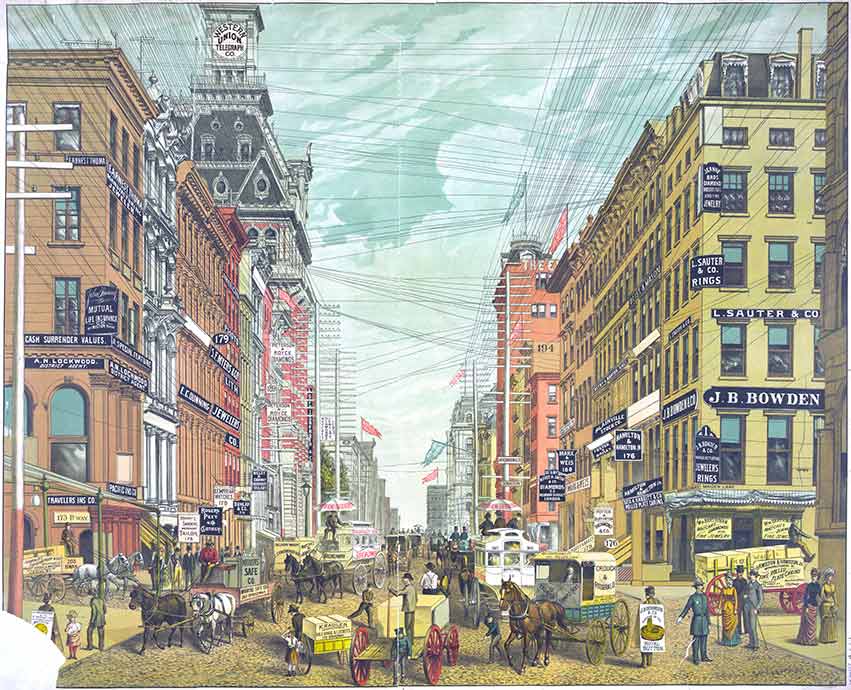
Still, though the New York Arcade was a failure, Maiden Lane itself remained a bustling center for shopping throughout the 20th century, especially for precious metals and stones; by the middle of the 1900s, it was well-known as the Jewelry District, which has since relocated to the area near West 47th Street. Many of the most prominent American jewelers and clockmakers of the time first set up shop on Maiden Lane, including William Barthman Jewellers, whose bronze and glass clock still tells the correct time to this day from where it lies embedded in the sidewalk, at the street’s Broadway intersection.
[pdf-embedder url=”https://www.hellobigapple.net/wp-content/uploads/2018/02/Maiden-Lane-1929.pdf” title=”Maiden Lane 1929″]
First New York Slave Revolt
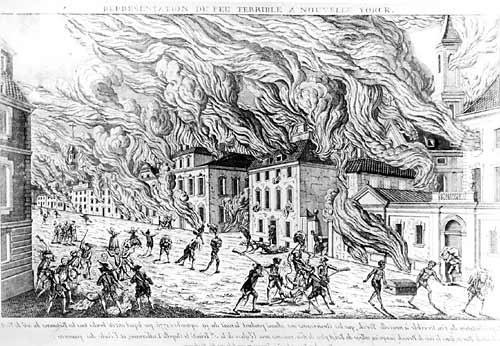
Throughout the 18th century, Maiden Lane saw plenty of action. On April 6, 1712, New York’s first slave revolt took place on Maiden Lane thanks to goings-on at a nearby slave market near Wall Street and the East River. 23 black slaves revolted, killing nine white men and women and injuring six other whites.
In September 1732, the birthplace of professional theatre in New York came into being when a group of actors set up house in an upstairs room of a building at the corner of Maiden Lane and Pearl Street that they had fitted with a stage; the company ran regular shows out of this “theater,” known as The Play House, until its closing two years later, in 1734.

Residents of Maiden Lane
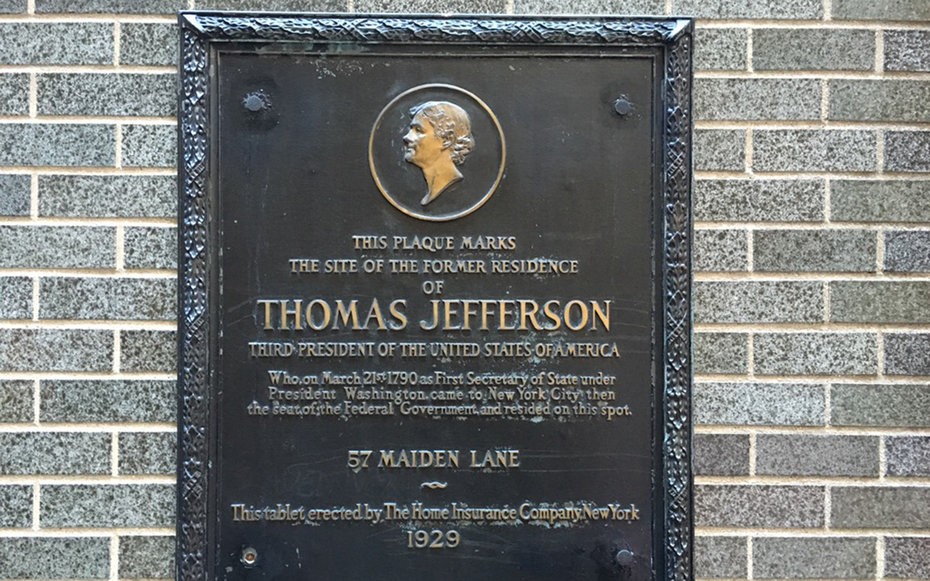
In the spring of 1790, Thomas Jefferson rented a house at 57 Maiden Lane when he moved to New York to serve as the Secretary of State under George Washington. His dinner on June 20, 1790 at that house with Alexander Hamilton and James Madison produced the Compromise of 1790, whereby Hamilton won the decision for the national government to take over and pay the state debts, while Jefferson and Madison obtained the national capital (District of Columbia) for the South. The dinner was celebrated in the song “The Room Where It Happens” in the Broadway musical Hamilton.
Besides officials of the new government, Maiden Lane also was the home to some very interesting characters mostly lost to history.
Captain Lourens Cornelissen Vanderwel built a home here during 1691. He described himself as the “Skipper under God of the ship the Angel Gabriel.” He failed to improve his land and forfeited a portion of it to Indian trader Sander Leendertsen. Leendertsen’s real name was Alexander “Sandy” Lindesay of the Glen, a Scotsman descended from Sir David Lindesay, a 16th century poet. He built his house on what had been the skipper’s garden and then left New Amsterdam to become one of the pioneers of a new settlement known as Schenectady. Remains of his well are believed to exist under Pearl Street.
Another resident was the Screeching Woman of Maiden Lane. Before street lighting, Maiden Lane was a very dark area of the city. Stories and rumors were the buzz of neighbors, including that of an evil terror present at night that frightened residents. A shriek of a night-strolling woman paralyzed those who heard it and one contemporary wrote:
Famous landmarks
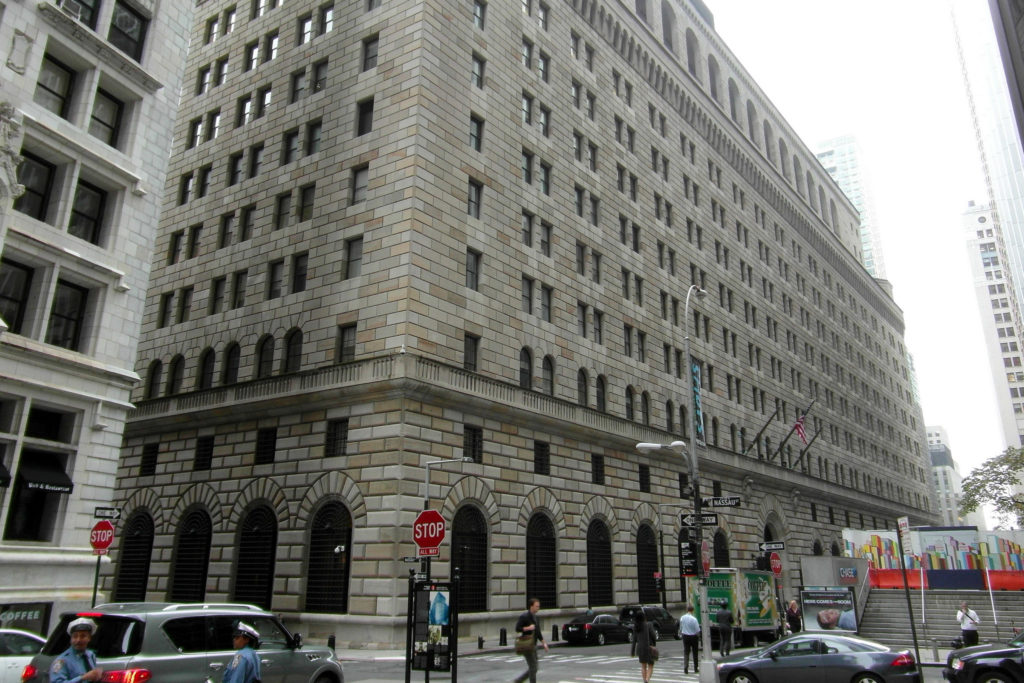
Maiden Lane now hosts such significant edifices as The Federal Reserve of New York, the Continental Center, the Cushman Building, and the Goldsmiths’ and Silversmiths’ Building, evoking an eclectic mix of modernist, neoclassicist, and beaux arts architecture all along the lane. Also home to several local shops and restaurants, the street fuses the area’s overall impression of business authority with an air of community and an artistic sensibility.
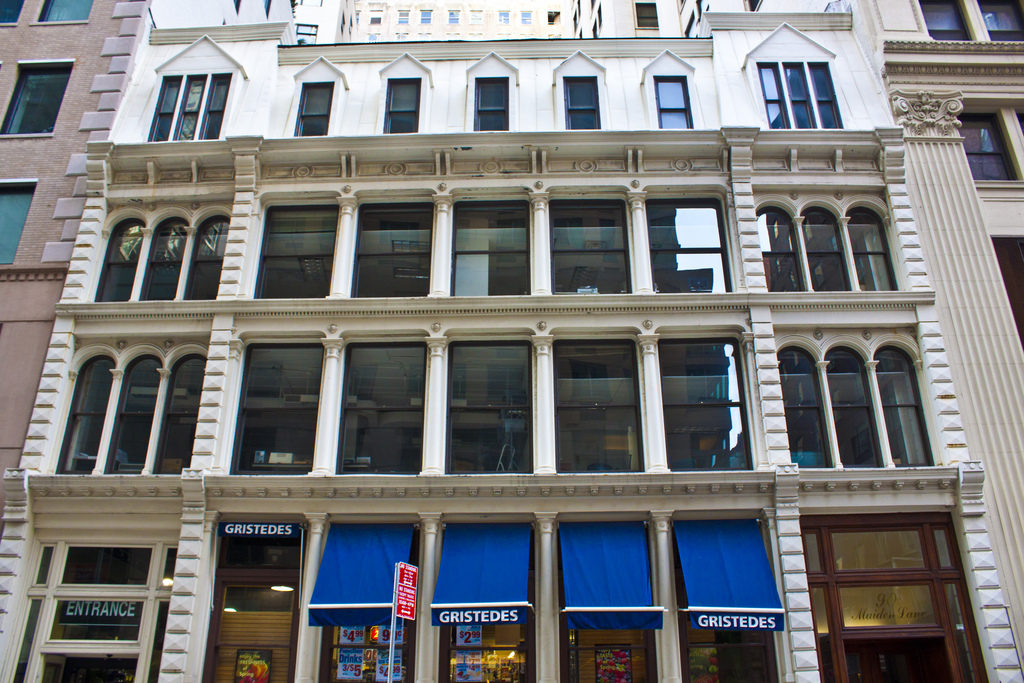
One of the handful of mid-19th century commercial structures still standing in the Financial District, is the building 90-94 Maiden Lane. It has a cast-iron façade from Daniel D. Badger’s Architectural Iron Works, and is one of the few surviving examples of cast-iron architecture between Fulton Street and the Battery, as well as one of the handful of mid-19th century commercial buildings extant in Lower Manhattan.
The building’s façade was commissioned by Roosevelt & Son, the leading plate glass and mirror importer; Theodore Roosevelt Sr., the father of the U.S. President of the same name, was one of the company’s principals. Unlike most other buildings of its sort, it has not been converted into condominium apartments, and is still in use as a commercial building. The building was designated a New York City landmark on August 1, 1989.
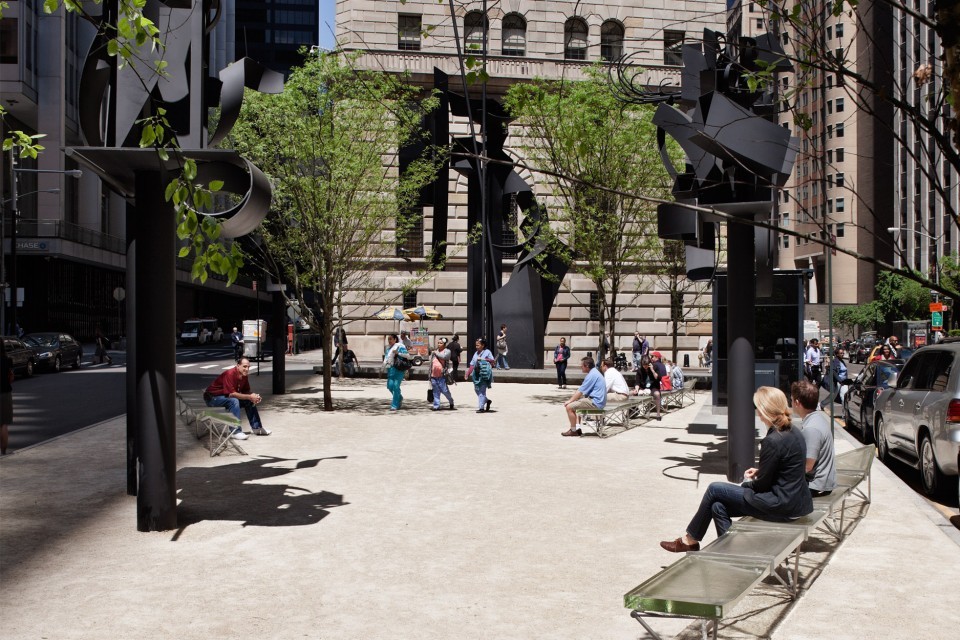
In 1977, the Louise Nevelson Plaza, a triangular-shaped plaza at William Street, opened. Louise Nevelson Plaza on Maiden Lane is the first public place to be named after an artist in New York, a feat for a female artist. Several Cor-Ten sculptures can be seen in this park.
Maiden Lane today
Today, the street links past to present, commerce to community, and remains a prominent standby of New York’s fascinating history as one of the oldest cities in the U.S. So the next time you’re in the financial district, take a stroll down this old lovers’ lane, and really feel the lifeblood of New York City in its worn down stones. Take in the the view of the waterfront, and perhaps conjure up a less civilized time, when the burning of buildings usually meant slave revolts or revolutionary battles. Or, if you’re hoping for a more peaceful exploration of Maiden Lane, you could envision stylish couples searching for engagement rings here close to the turn of the century. Either way, Maiden Lane still has plenty to offer the casual observer of life in NYC.
Did you know?
Maiden Lane also has its own song. It was written by Alicia Lake and inspired by the experience of her colleague who was present in NYC on 9/11. As a photographer, he took pictures of the event as it was unfolding. And at the same time, he commandeered a van and drove around the city into the evening, picking up injured people in the streets and taking them down Maiden Lane to safety and medical care.
Inspired by, and commemorating her friends heroic act, as well as celebrating the lives of the victims and survivors of the attack, Alicia wrote the song “Maiden Lane.” She wrote it in it’s entirety in 20 minutes after waking from a dream. She sings it accapella in the video, along with 3 backup harmonists.
Lyrics:
Hear now
Hear the angels call
The angels calling your name
Here now
When your heart breaks at dawn
The angels will call out your name
Fear not
When darkness falls
My candles are guiding your way
Fear not
That the sky has fallen
Just follow me down Maiden Lane
Follow me down Maiden Lane
Down Maiden Lane we’ll go
When the tallest tower can’t hold your faith
It’s Maiden Lane we’ll know
So hold on
Hold on to me now
Hold on, I’ll carry you through
We’ll know
When morning has come
That morning has come back for you
Follow me down Maiden Lane
Down Maiden Lane we’ll go
When the tallest tower can’t hold your faith
It’s Maiden Lane we’ll know
Sleep now
Sleep like the angels
Dream as the innocent do
‘Cause we’ll rise
We’ll rise from the ashes
And someday I’ll get back to you
Follow me down Maiden Lane
Down Maiden Lane we’ll go
When the tallest tower can’t hold your faith
It’s Maiden Lane we’ll know
Are you into NYC history? Click here to read more.

